
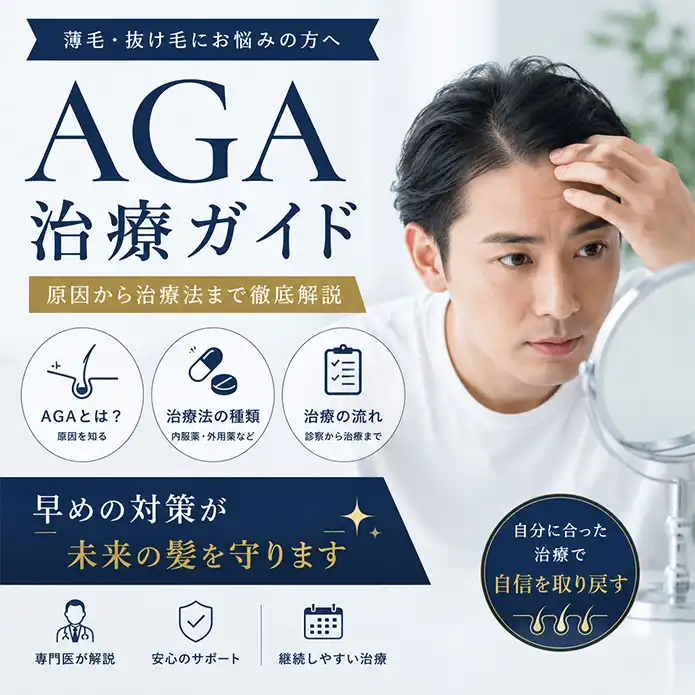
When people start to worry about thinning hair, the first question many have is, “What treatment options are actually available?” A quick internet search reveals a variety of options, including oral medications, topical treatments, injections, and hair transplants, which can often make it even more confusing to know what to choose. This article will carefully explain each of the main AGA treatment options, outlining how each works and who it’s best suited for.
1. Basic concepts you should know before choosing a treatment
1. Instead of “curing,” “manage the progression.”
Most AGA treatments aim to maintain existing hair and slow down the progression of hair loss, rather than completely restoring lost hair. Since it is difficult to reactivate hair follicles that have already completely ceased activity, the treatment goal is generally set as “maintaining the current state” or “gradual improvement.” This does not mean that the treatment is ineffective; rather, having realistic expectations can increase satisfaction with the treatment and the rate of continuation.
1-2. No single treatment is suitable for everyone.
The optimal treatment varies from person to person depending on the stage of progression, the combination of causes, constitution, and lifestyle. A method that works for one person may not be suitable for another. Therefore, it’s crucial to consult with a doctor to find the method that’s right for you, rather than sticking to one method based on self-diagnosis.
1-3. Understand the time it takes for the effects to appear.
AGA treatment is not an immediate solution. The hair cycle (the cycle from when hair is born until it falls out) operates on a monthly basis, so it generally takes at least several months, and sometimes more than six months, to see noticeable results. If you prematurely conclude that the treatment is ineffective without understanding this timeframe, you may miss out on improvements that you could have otherwise achieved.
2. Treatment with oral medication
2-1. Types that suppress DHT production
Oral medications that suppress the production of DHT (dihydrotestosterone), the main cause of AGA (androgenetic alopecia), are considered one of the central treatment options for AGA. By blocking the action of an enzyme called 5α-reductase, the aim is to reduce the amount of testosterone converted to DHT and lessen the burden on hair follicles.
Suitable for: People experiencing receding hairlines or thinning hair on the crown of their head who want to address the underlying hormonal imbalances.
Things to know: Continuous use is necessary to experience the effects, and discontinuing use on your own may cause the effects to gradually diminish. Whether or not there are side effects and whether the medication is suitable for you must be determined under the supervision of a doctor.
2-2. Types that support blood flow and hair follicle function
Apart from direct approaches to DHT, there are also oral medications aimed at improving blood flow to the scalp or supporting hair follicle metabolism. These may be used alone or in combination with DHT-inhibiting drugs.
3. Treatment with topical medications
3-1. Type applied directly to the scalp
Topical medications are applied directly to the scalp to promote blood flow around the hair follicles and support hair growth. Unlike oral medications, they are often characterized by having limited systemic effects, making them an option for people who are hesitant to take oral medications.
Suitable for: People who want to use this in conjunction with oral medication, or people who are hesitant to take oral medication.
Things to know: You may experience a temporary increase in hair loss (so-called initial shedding) when you first start using the product. This is often considered a temporary phenomenon associated with the transition to a new hair cycle, and it generally subsides as you continue using the product. However, if you have any concerning symptoms, it is important to consult a doctor rather than self-diagnose.
3-2. Concomitant use with oral medications
Because topical and oral medications work through different mechanisms, combining them can sometimes allow for a combined approach to treatment. The most suitable combination depends on the stage of the disease and the individual’s constitution, so it is advisable to consult with a doctor to determine the best approach.
4. Injection treatments (such as mesotherapy)
4-1. An approach involving direct injection into the scalp
While oral and topical medications approach the problem from the entire body or the scalp surface, injection therapy aims to act more locally by directly injecting active ingredients into the area around the hair follicles in the scalp. Ingredients such as growth factors are often used, with the goal of activating the hair follicles.
Suitable for: People who feel that oral and topical medications alone are insufficient, and those who desire a more proactive approach.
Things to know: Treatment generally requires regular visits to the clinic, and costs and frequency of treatments vary depending on the clinic. It is important to receive a thorough explanation of the treatment and the ingredients used beforehand.
5.The option of hair transplantation
5-1. From “Maintenance” to “Transplantation”
While oral medications, topical medications, and injection treatments all aim to “maintain and activate existing hair follicles,” hair transplantation is a fundamentally different approach, involving transplanting hair follicles from the back or sides of the head, which are considered less susceptible to the effects of AGA, to areas where hair thinning has progressed.
Suitable for: People whose hair loss is already quite advanced and who cannot expect sufficient visible changes from other treatments alone.
Things to know: Because it is a surgical procedure, it requires different considerations than other treatments, including downtime (recovery period after the procedure) and cost. Also, since the hair in areas other than the transplanted area may continue to be affected by AGA, it is common to continue other treatments in parallel after hair transplantation.
6. Perspectives for comparing treatment methods
| treatment | span | Main Feature |
| Oral medications (DHT inhibitors) | Intervention in hormone function | One of the main treatment options for AGA (androgenetic alopecia). Continuous use is required. |
| Topical pharmacy | Direct application to the scalp | Its systemic effects are considered to be limited. It is often used in combination with oral medications. |
| Injection treatment | Direct approach to hair follicles | A more localized and proactive approach. Regular hospital visits are necessary. |
| Hair transplantation | Transplantation of the hair follicle itself | A fundamental approach to advanced hair loss: Surgical treatment. |
Each treatment method has its own characteristics, and it’s impossible to say definitively that “this is the best.” A realistic approach is to consult with your doctor and choose a treatment method that takes into account the stage of the disease, the desired degree of change, the time you can dedicate to hospital visits, your budget, and other factors.
7. Lifestyle habits to be mindful of alongside treatment
While not a treatment itself, the following lifestyle habits are believed to serve as a foundation that supports the effectiveness of any treatment method chosen.
- Get enough sleep
- A balanced diet (especially intake of protein, vitamins, and minerals)
- Avoid excessive drinking and smoking.
- Keep your scalp clean
- Avoid accumulating too much chronic stress.
While it’s generally considered difficult to stop the progression of AGA with these methods alone, they are considering as a foundation for maximizing the effectiveness of treatment.
8. Frequently Asked Questions (FAQ)
Q1. Which treatment method is the most effective?
It’s impossible to give a general answer. The treatment varies from person to person depending on the stage of progression and the combination of causes. It’s important to find the method that’s right for you through consultation with your doctor.
Q2. Is it possible to undergo multiple treatments simultaneously?
It is not uncommon to combine multiple approaches, such as using oral medications and topical medications together. However, a doctor’s judgment is necessary to determine the appropriateness of the combination.
Q3. What happens if I stop treatment?
The effects obtained from treatment may gradually diminish after discontinuation. It is advisable to consult with your doctor before deciding whether or not to continue treatment.
Q4. How much will it cost?
Treatment costs vary greatly depending on the method and clinic. Injection treatments and hair transplants, in particular, tend to be more expensive than oral or topical medications. It is important to receive a thorough explanation beforehand and make an informed decision.
Q5. How long will the treatment take?
It generally takes several months to see noticeable results. It’s important not to judge the outcome in the short term, but to maintain a consistent approach.
9. Summary
There are several options for treating AGA (Androgenetic Alopecia), including oral medications, topical medications, injections, and hair transplantation. Each approach and the person it’s best suited for differs, so there’s no single “right” answer. The important thing is to find a method that suits your stage of hair loss and your preferences by consulting with a doctor. If you notice any concerning changes, we recommend starting by getting an accurate assessment of your condition at a specialized clinic.
Disclaimer
This article is for general informational purposes only and is not intended as a diagnosis or treatment. For treatment of thinning hair or hair loss, please consult a dermatologist or a specialized AGA (Androgenetic Alopecia) clinic.